If you follow tech news, you have surely seen tons of critical reviews of the new iPhone 18 Pro and Duo.
While walking my dog I watched (well, listened to) about three of them, and they all tell a similar story: Apple has lost its touch, the devices are weak, there are loads of flaws.
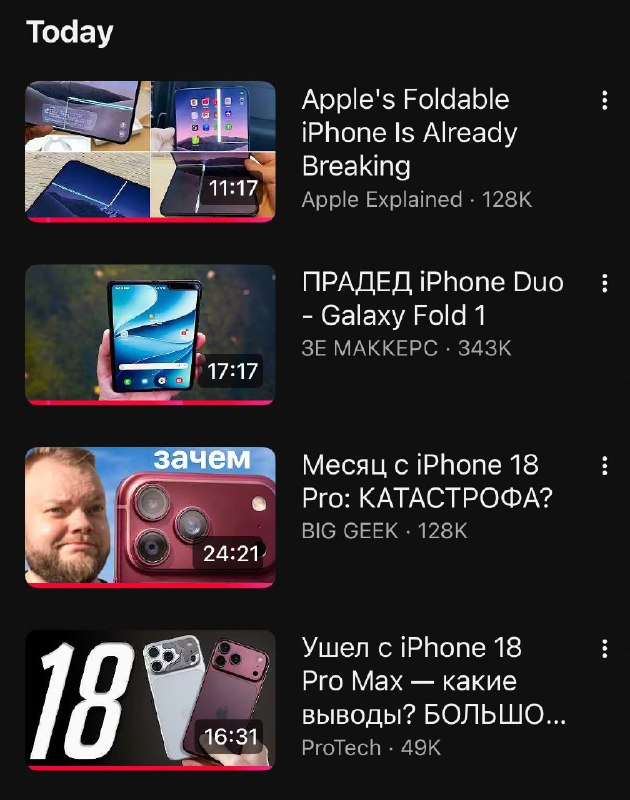
Polarisation around Apple products is, broadly, part of the love/hate culture that has surrounded the company for a long time. But this year, it seems to me, Apple has taken a particularly heavy beating, including from people who used to count themselves among its fans.
Below is my take on the negativity around the new releases. And it’s a story less about Apple than about how we judge technology today.
There have always been flaws
Remember 2007 and the first iPhone. It had no App Store and no video recording, and it didn’t support 3G or MMS, even though competitors had long had many of these features (I remember my own Toshiba Portégé G810).
In 2010 Apple released the iPhone 4 with the legendary Antennagate: the phone lost signal if you held it a certain way. The problem was serious enough that Consumer Reports refused to recommend the device, and Steve Jobs had to hold a dedicated press conference and offer owners free “bumpers”.
Then came the bending iPhone 6 (Bendgate).
All in all, there have always been flaws. Yet for some reason modern reviews leave you with the impression that Apple used to make perfect devices and has now forgotten how.
The media have changed
In the almost 20 years since the first iPhone was announced, tech journalism in particular and the media landscape in general have changed radically.
Yes, critical reviews existed before. On the day the first iPhone was announced, for example, Engadget ran a piece called “The iPhone is not a smartphone”, and Eldar Murtazin (some of my readers may remember the pre-YouTube era and the text reviews on Mobile-Review) tore the device to pieces (in Russian; figuratively speaking).
Still, back then there weren’t thousands of specialised bloggers and independent testers, each working in their own narrow niche. Judge for yourself:
- one blogger compares the colour accuracy of different manufacturers’ panels in the same model;
- another measures speaker performance and microphone quality;
- a third professionally scratches and destroys the casing;
- a fourth has been dropping new smartphones onto concrete for years to show us how they deform;
- a fifth studies how the processor behaves under sustained load, and a sixth examines, under a microscope, the pixel grid in the area of the screen above the Face ID infrared camera (that’s no exaggeration).
Each of them produces content that other bloggers, the media, social networks and algorithms pick up.
If the content is negative, it gets more clicks (“SHOCK! APPLE FLOPS WITH ITS NEW FLIP PHONE!”) — that’s a basic rule of media.
If you’re curious, you can read a study of how the emotional tone of headlines affects click-through on news. In short, the main finding is that each additional negative word in an average-length headline increased the CTR by 2.3% on average.
That doesn’t mean all tech bloggers deliberately blow problems out of proportion (although, wait…), but it illustrates well the obvious economic incentive that led to the current situation:
a “spicier” story → more clicks → more views → more comments → the video gets recommended more often → more views, and so on.
What’s more, sometimes a huge echo chamber forms: one blogger discovers a flaw, dozens of others pick it up, and recommendation algorithms amplify the discussion many times over.
And soon it looks as if the new iPhone has a fundamental quality problem, even though often what we see is not dozens of independent confirmations but dozens of retellings of the same story.
That doesn’t make the original problem made up. It’s just that the scale of the noise stops matching the scale of the problem itself.
Users have changed
The next factor is users’ growing technical literacy.
In 2007 the average user literally had to be taught how to use new interfaces, because smartphones weren’t yet a mature product category.
Remember the skeuomorphism of the first generations of iOS: leather covers, wooden bookshelves, paper notepads and other visual metaphors of the physical world. The interface practically shouted: “Look! The notes on your phone are like the notes on your desk, only digital!”
By the way, that’s one of the reasons I didn’t switch to the iPhone until the iPhone 6 Plus. That generation brought a big screen together with an interface familiar to an Android user. Thanks to the “flat” iOS 7, which Apple moved to thanks to Jony Ive: after Scott Forstall left, he took charge of software design as well as hardware.
And yes, it’s awkward to admit, but I was that guy who mocked iOS users, shouting: “Ha! You paid ten times more for specs that Android already has! You’re VICTIMS OF MARKETING!” Back then I was a hardcore Android fan with an HTC Desire, Google Nexus phones by LG and Samsung, an HTC One and a Meizu MX4 Pro behind me.
Today skeuomorphism looks archaic (although we can see Apple gradually moving away from flat interfaces and drawing more and more inspiration from 2000’s Aqua), but back then such choices helped users carry familiar ways of handling physical objects over into the digital world.
What’s more, this was a big part of the early Apple magic. The company didn’t just offer new technology; it made it understandable to people who had never encountered it before.
As a Toshiba Portégé G810 owner, I can confirm that pinch-to-zoom on photos amazed me, as did the game where you tilted the phone to roll balls into holes. I was very jealous of a classmate with an iPhone and tried to train myself to pull out my stylus faster.
In 2026 the situation is fundamentally different.
There are far more people interested in technology, and their understanding of how their gadgets work is much deeper. A savvy user knows about OLED, LTPO, throttling, PWM and so on. An ordinary user can tell Bluetooth from Wi-Fi and compare the megapixels in different phones’ cameras.
Thanks to YouTube, you don’t even have to understand it all yourself. It’s enough to find a blogger who has already run the tests and explained the results.
It turns out we have become better not only at understanding how technology works, but also at knowing exactly where to look for flaws.
And if in 2007 Apple offered a fundamentally new user experience, for which people were willing to put up with lots of limitations, today the difference between generations is far less noticeable, and the core use cases have long been covered.
As a result, attention naturally shifts from revolutionary capabilities to the details of how existing ones are implemented. A new iPhone no longer surprises us simply by existing, so we discuss not what it can do, but how well a particular feature is implemented (relative to competitors, of which there are also more now).
The products themselves have changed
A modern smartphone is incomparably more complex than its 2007 ancestor. The number of hardware components, software features, use cases and potential points of failure has grown enormously.
Claude kindly worked out for me how the “weight” of iOS grew from the first version to the latest: more than 130 times! iPhone OS 1.0 and iOS 27 are completely different systems in scale and functionality, even though formally they are the evolution of the same operating system.
Remember, too, that Apple has split its lineup up a lot compared with the first iPhones (if I remember correctly, at first there was one colour, and later we were given a choice of white or black). Today’s lineup consists of six (!) different devices:
- iPhone 17;
- iPhone 17e;
- iPhone Air;
- iPhone 18 Pro;
- iPhone 18 Pro Max;
- iPhone Duo.
Six devices with different hardware and different product philosophies (for example, the screen-switching animation is needed only by the Duo, but my guess is that it ships in iOS for every device). Imagine how much “junk” has piled up under the hood over the years.
Today a smartphone drives a huge number of hardware components, runs thousands of APIs, talks to cloud services, processes vast amounts of data and supports use cases that simply didn’t exist 20 years ago.
Add to that the ongoing miniaturisation and the many-fold growth in hardware complexity. The process node has shrunk from 90 to 2 nm, storage has grown from 4 GB to 2 TB, and the number of pixels on the screen by 20 times. There are billions of transistors inside the chip, and the processor has to deliver high performance and energy efficiency and run ever more complex AI models, all at once.
And here an interesting question arises: how fair is it to compare the quality of products from different generations simply by the number of flaws found?
The first iPhone, for example, couldn’t have had problems with video quality, because it couldn’t record video at all.
So, roughly speaking, the iPhone 1 had 10 features and one of them didn’t work properly. The iPhone Duo has, roughly, 100 features, 5 of which don’t work properly. There are 10 times more features, 5 times more broken features in absolute terms, but the share of broken features is half as large.
It’s a simplified example: one critical bug can be far more serious than a hundred minor flaws. But it shows well why the number of problems found says little about a product’s real quality on its own and can’t prove that quality has dropped.
Important: I’m not defending Apple, and I’m not claiming that more complex technology inevitably means more bugs. Development, testing and quality-control tools are improving too. Still, the number of potential points of failure and of scenarios that need testing has become incomparably larger.
Apple raised the bar for itself
And here another problem arises, one Apple created for itself.
Think Different, the cult of attention to detail, uncompromising quality and premium pricing. For years the company built up the expectation of a perfect product, so for Apple’s audience any problem feels like a disaster.
Hence the caustic reaction from people who follow technology, for whom Apple’s problems with the Duo’s inner display look doubly absurd: announcing a “revolutionary approach” seven years after the Samsung Galaxy Fold reached the market, and then getting scathing reviews in the first week of sales, is the height of absurdity.
Samsung, Google and other manufacturers have long been making devices at a comparable price, and some models cost even more than an iPhone. They also have problems with heat, battery life, software stability, build quality and so on.
But Apple gets hit for flaws that audiences react to more calmly when it comes to other manufacturers. I think that’s a direct consequence of Apple having historically set higher expectations for the quality of its products.
I stopped being an Apple fanboy long ago and genuinely believe the company has lost much of its innovation leadership and today more often “polishes” existing technologies than offers fundamentally new ways of interacting with them (the question is how much polishing, since the first iPhone was also built from technologies already on the market).
What’s more, technologies that are already mature are sometimes implemented in ways that are puzzling, to put it mildly. For example, it genuinely annoys me that a $1000 iPhone 15 Pro Max can’t record Telegram video messages because it overheats during the chilla, the peak of Tashkent’s summer heat.
Or that Apple literally had to be forced to switch to the far more convenient and widespread USB-C (thanks, European Commission). And fast wired charging only came slightly closer to the speed of Chinese flagships with the iPhone 18.
If you sell a device for $1000–1500 and position it as the pinnacle of engineering (at least in your marketing), kindly live up to it.
That said, I still consider the iPhone one of the best smartphones in terms of how well hardware and software fit together, stability and the predictability of the user experience.
The bottom line
In my view, the amount of negative content shouldn’t be taken as an objective measure of a product’s quality (the same principle, by the way, applies to people: today it’s very easy to create the illusion of a terrible reputation).
And this isn’t only about Apple.
Perhaps modern smartphones really have become less reliable. Perhaps the opposite. Answering that would take comparable data on real failures, errors and user problems across generations, and I don’t have such data.
But the number of videos titled “MANUFACTURER X HAS FAILED AND IS GOING UNDER” certainly can’t serve as that metric: we have become far better at detecting and discussing technology’s flaws than at judging how much they actually matter.
First published in my Telegram channel (in Russian) on 8 and 15 November 2026: t.me/raschet7/330, t.me/raschet7/331 and t.me/raschet7/332.