1. Feeling stupid in a new industry (for the first six months) is normal
I didn’t understand 70% of what my colleagues were talking about: goods receipts, write-offs, SAP transactions, dead stock, OSA, On Time, In Full. It was unsettling, and at the start I was very nervous: little time, lots of tasks, people expecting results from me, and there I was in meetings, blinking and not understanding what was being discussed.
At some point I started meticulously taking notes on literally every meeting so I could calmly work out later what it had all been about.
I got over the fear of looking stupid and started asking lots of “primitive” questions, asking about the same thing three times and asking people to explain it to me “like I’m five”.
It turned out that a sensible, competent specialist can explain almost any concept in plain terms. What’s more, they’re even glad to tell you how things work, because they find it interesting.
The most striking example for me was the payment gateway (aka middleware): I was figuring out on the fly what it was, why it was needed and how it worked. I ended up with a simple little diagram in Miro that made 90% of potential contractors laugh or look puzzled.
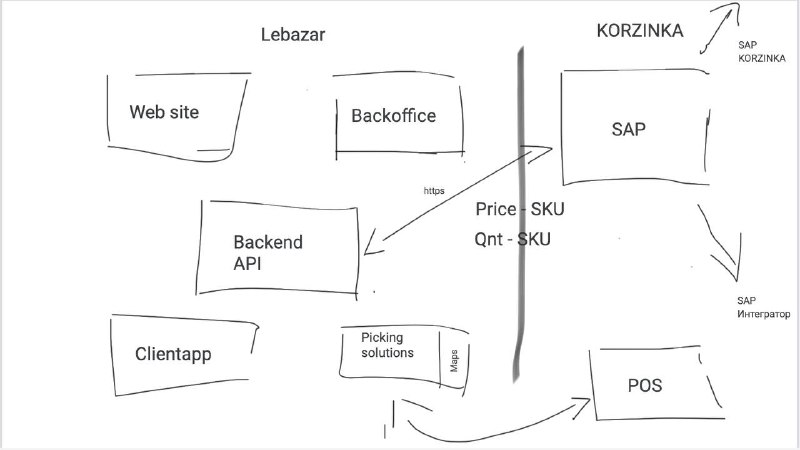
What’s more, I once had a call with an experienced payments product manager (another hack for getting into a subject quickly), and he shook his head with a serious face and said something like:
You can’t build something this complex with such a primitive level of understanding. You need a proper systems architect, or you’ll spend a pile of money and time and get nothing. And you, for a start, should learn to draw proper sequence diagrams.
The story ended with Zhenya Nelepko recommending a call with a good friend of his who had “done something similar”. That was Artyom Belikov and his team: in six months we built everything needed to launch the service with them, and we still work together productively, making our product better and better.
Artyom didn’t laugh at my diagrams, didn’t talk down to me, didn’t try to confuse me with dozens of complex terms or charge extra to “sort out the spec”.
He explained simply and easily how to implement technically what I was asking for. Thank you, Artyom!
And one more bonus of behaving this way: it became hard to manipulate me with lines like “you don’t understand anything, I’ve been in this field for 10 years”. I calmly admit that I don’t understand and ask for help working it out, without feeling awkward or ashamed.
In the past, faced with a question like “You do understand how this works, right?”, I might have said yes out of fear of looking incompetent. Now I gladly seize the chance to get to grips with a new subject and calmly admit what I don’t know, sometimes exposing the other person’s incompetence along the way.
2. Overworking is normal if it’s a conscious choice
Not everyone needs work-life balance — I wrote about that. Now I’d add to my own words: it’s normal to live in cycles.
For 3–6 months I work 12-hour days, and then for 3 months I work just 8 and spend the evenings on sport or TV series. Some days I can’t do anything at all except go through my email.
I’ve accepted that I can’t perform at a consistently high level for X months in a row. When my productivity dips, I’ve stopped pushing myself and beating myself up about it, and accepted it as an inevitable recovery process — something to enjoy, not a reason to feel ashamed of my “low” performance.
And the other way round: if I have the energy and the desire to work from morning till night, with no days off, why not use that time and enjoy the work?
3. Doing hands-on work and “minor” tasks (even with a “fancy” job title) is normal
Having already built a team of seven wonderful product managers and holding the coveted letter “C” in my job title, I kept rebooting the router in the server room, discussing with the cleaning lady how often to clean the filters in the office water cooler and air conditioners, and setting up access to email and corporate services by hand.
And it wasn’t that I didn’t want to or couldn’t delegate, prioritised badly or anything like that. We simply had (and still have) a very compact team, and we couldn’t afford to hire an HRBP, a network administrator, an office manager and so on.
And handing such tasks to people on the product team is inefficient and expensive: they invest their time in important projects and products. So I end up dealing (outside working hours) with the “little things” without which working in an office can turn into a nightmare. Try sitting in an office some time with no air conditioning when it’s 45+ outside, the cooler water is undrinkable because the filters haven’t been cleaned for X months, and on top of that the internet keeps dropping.
This behaviour has another positive effect: the team sees that their manager isn’t shy about rolling up his sleeves and will do any task if circumstances require it.
So people start taking the initiative themselves and making the processes and the space around them better and more convenient. Plus, a request to help with some minor issue isn’t taken as “right, he’s dumped some stupid crap on me”: people have seen me do such tasks myself and understand that my request doesn’t belittle their professional skills in the least.
4. Working on a task for a long time and getting results later is normal
And it doesn’t contradict the idea of “speed” in start-ups.
For a long time I believed that Skyeng-style management, with its ultra-structured approach, endless frameworks for every occasion and talking only in numbers, was a universal remedy for the hardest situations.
How irritated I was in my first months at Korzinka when my usual approaches didn’t work. It drove me mad that just writing in Slack or calling on Zoom wasn’t enough: you had to phone, introduce yourself, ask how the other person was doing (and I was a fierce hater of small talk, which I considered a waste of time), suggest meeting for breakfast or lunch to get to know each other better. And only after this ceremony, some time later, could you get down to solving problems.
I was angry that I had to “spend” heaps of time aligning context and explaining again and again to different people (and sometimes the same ones) why we were doing what we were doing and why it was important to help us.
I honestly thought it was unnecessary and far too costly to build any relationships with people other than work ones.
I expected instant results and got annoyed when I had to fight again and again to get what seemed to me an elementary task done (for example, it took us months to get used to using Slack, booking meetings in calendars and writing agendas in advance).
Some meetings (the weekly operations committee, for example) we’ve been honing for more than two years to learn to run them as effectively as possible. And that’s normal.
I don’t know whether you can call it “Eastern wisdom”, but at some point (not without the help of regular conversations with Kostya) I calmed down and saw how tasks we had worked on for months began to bear fruit and projects naturally “reached full capacity”. It’s a great feeling that gives a new level of confidence in yourself and your abilities: I can see that I’m capable not only of quick “dopamine” wins but also of delivering strategically important initiatives.
5. Management is about a set of tools and knowing which one to use when
I know it sounds obvious, but let me explain with my own example.
Besides my love of frameworks, processes and data, I brought something else from my previous job: pressure.
My early approach to management was a perfect illustration of the saying:
When all you have is a hammer, everything looks like a nail.
I thought that putting pressure on colleagues, on the team, on partners was a good tactic.
They won’t make concessions? Push. They missed a deadline? Show them what maximum pressure looks like!
Imagine my confusion when this “universal” tool, which had served me faithfully for years, simply stopped working.
I started getting “developmental feedback” from partners and from the team and, most importantly, I stopped getting results.
At some point, with Kostya’s help, I realised that everyone’s workload was so high that pressure was simply pointless: however much they wanted to, they couldn’t do it faster, cheaper or better, and we had to find other ways to solve the problems that came up.
So now our discussions of difficult projects and problem cases start with “How can I/we help solve this problem?” or “What can we do to…”
6. Without trust it’s hard to deliver outstanding results
I’ve written about this before; now I’ll expand on it a little.
I used to smirk when I heard about the concept of “leadership” and genuinely believed that nothing could replace processes, frameworks and His Majesty PRESSURE (plus a generous handful of micromanagement now and then).
But it was at Korzinka Go that I realised processes won’t help mobilise a team in an extreme situation, when a task has to be pushed over the line even though the working day is over. Or when you have to react quickly to the service going down at the weekend.
At a certain stage of a product’s growth you can’t foresee and describe everything, so it matters more than ever to know you’re not alone: the team will pick things up and back you up, take the initiative and act on its own.
You can’t force people to help; you can only inspire them. About a year ago I was exchanging voice messages with my former colleague Yulia Chebotar, with whom I worked at Yandex (I’m very grateful to her for carrying a huge amount of responsibility and handling her tasks brilliantly; Yulia, well done and thank you!), and she remarked that I seemed to have become more emotionally open.
At Skyeng I went through letting dozens of people go, so at some point I decided not to get emotionally close to the team and to keep fairly strict personal boundaries, so that if it came to it, saying goodbye wouldn’t hurt.
With that stance, relationships of trust are simply impossible, which means you can’t count on help and support from the team “beyond the call of duty” (after all, I didn’t show any as a manager).
At Korzinka Go I stopped (well, maybe it still slips out sometimes) rallying the team with negativity (“we’ll smash / tear apart / destroy them”) and started talking more often about the prospects that await us if we pull off one ambitious task or another.
I started allowing myself to joke and to take friendly jokes at my expense lightly (instead of reacting sharply along the lines of “I’m the boss, how dare you joke about my bald head!!1”).
Truly strong people won’t work in an atmosphere of micromanagement, manipulation and toxicity.
Pressure on them is pointless, because a strong specialist works out of interest and knows they can find a new job at any moment where they’ll be treated with respect.
And strong people give constructive, direct feedback, which helps processes inside the team and the company evolve faster.
7. Competition is a blessing
I always reacted nervously to new competitors. At Skyeng I regularly went to my manager and said, with anxiety in my voice: “Look, company X has launched its own language school. What are we going to do now?!”
At Yandex it was calmer: I knew we were part of a huge corporation and would come up with something.
This trait showed most vividly while I was growing Hvost: I obsessively tracked the salons opening nearby, spent hours watching competitors’ YouTube channels and lay awake at night worrying that we hadn’t outbid them for ranking on 2GIS.
In Tashkent I rethought the idea of competition and learned to look at it from a different angle. Two years ago we were completely alone in the e‑grocery market. Now the market has Yandex Eats, Uzum Tezkor, Wolt, Oq-Ot (haven’t heard anything from them in a while), Kholodilnik and a number of smaller services.
On the one hand, we used to hold 100% of a market worth, roughly speaking, $1 million. On the other hand, with new players the market has grown too, so even 11% of a $100 million market is more than 100% of a $1 million one.
Instead of fearing how fast Yandex Eats was growing, we partnered with them and got a significant boost in orders, while giving Yandex Eats users access to new ways of using the service.
We managed the same with Uzum Tezkor: they have a strategic partner in the grocery segment, Makro. And even though Makro is a direct competitor of Korzinka, we found mutually beneficial (win-win) terms and let Tezkor users order groceries from Korzinka in the interface they’re used to.
Another example: the e‑grocery service Kholodilnik (“Fridge”) recently launched in Tashkent. They built a great app and competitive delivery speed, brought a number of innovations to the market (delivery in cardboard boxes, a free-delivery subscription, product search by photo) and so gave us an incentive to keep improving Korzinka Go.
8. I fully grasped the power of partnerships
A tough labour market and budget constraints led us to a partnership strategy, and it turned out that not having a huge development team (for example) can be not a problem but a blessing — at least at a certain stage of the market’s and the product’s development.
In the past I would have been afraid of such a model: “we don’t manage anything, we have no control”, “how can we plan and be accountable for deadlines and results”, and so on and so forth.
But for two years now we’ve been working side by side with dozens of external teams that help us with all kinds of tasks.
It turns out that “we don’t have our own developers” actually means “we can choose the best team on the market (sometimes the international one) with the deepest expertise in the area we need”.
In fact, specialists from Novardis, Atlant-Consulting, Servercore, Octo, Rakasta, Anor and others work on the Korzinka Go service.
Plus countless teams inside Korzinka without which the Go business simply couldn’t exist: Supply Chain, Commercial, Marketing, POS, SAP, Operations and so on.
And everything I’ve written about trust inside a team applies to cross-team work as well.
In closing
While writing this, I caught myself thinking I could keep drawing value from this experience for hours, but I’ll probably stop here and come back to the topic in a year, with the experience of overcoming new challenges in a new role.
To wrap up, I want to say a huge thank you to Uzbekistan, the Korzinka team and everyone at Korzinka Go for these two years, which made me better as a person and as a professional: I’ve become more patient, calmer, in some ways even more human.
Most importantly, I’ve fully felt how much relationships of trust and respect with colleagues, partners and people in general matter, and I seem to have started building my work on new values and principles.
First published in my Telegram channel (in Russian) on 13–16 November 2024: t.me/raschet7/139, t.me/raschet7/140, t.me/raschet7/141 and t.me/raschet7/142.