I joined Skyeng as a “manager for remote training of sales staff”.
It was my first job in IT, so I barely understood the difference between a project manager and a product manager. But I could clearly see how privileged the product managers’ position was.
They walked around with serious faces, used lots of incomprehensible words and — most irritating of all — CONSTANTLY spoke at all sorts of “product” conferences.
How it used to make me angry! Here we are, sweating away, trying hard, working overtime, and they go to conferences and ****** tell everyone how great they are!
Years later, when I became a product manager myself, it dawned on me that they went to conferences not to stroke their egos (or at least not only for that).
What a talk can do
Here’s a short list of things a conference can do for you:
- Strengthen the employer’s HR brand → this brings more inbound leads and makes hiring cheaper and faster;
- Build your personal brand → see above. People want to work with “cool experts”, so talks help create and maintain that image, which also helps hiring speed and the quality of inbound applications;
- Networking and partnerships → a successful talk can get you noticed by partners you couldn’t reach before. And a gripping talk helps you make useful contacts with people from companies whose experience you’d like to learn from;
- Strengthen your reputation as an expert → this may sound like the second point, but if for me a “personal brand” is about recognition (ah, yes, I’ve heard of this guy), an expert’s reputation is a different thing. Nobody knows how your life will turn out in the next X years, so a reputation as a good professional helps you feel confident about tomorrow.
And that’s far from the full list.
So I no longer consider speaking at conferences a waste of time.
Don’t overdo it
There is an important caveat, though: speaking too often can hurt your reputation more than not speaking at all.
Maybe it’s just my perception, but when I see a C‑level executive of company X at conferences in February, March, May, July, September, November and December, a reasonable question comes up: when do you find time to work, my friend?
The same question may occur to that executive’s colleagues, managers and board of directors. So don’t overdo it. I’ve set myself a norm of 2–3 talks a year.
How I prepare
Below is a real note describing how I prepared for a talk at Click Data MeetUp.
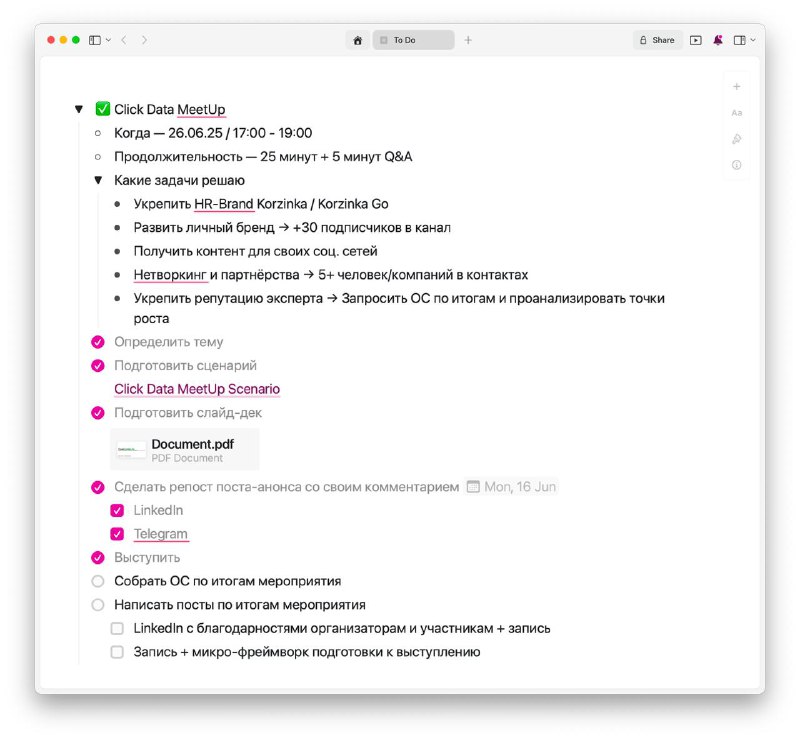
This structure lets me answer these questions for myself:
- Can I speak (do the date, time and location work);
- Do I want to speak (language, length of the talk, prep time);
- Why am I speaking and what do I want the talk to achieve (so that what?);
- What to do before the talk;
- What to do after the talk.
I’ll be glad if the framework proves useful. And I’d be grateful if you messaged me about what public speaking does for you.
The deck, script and recording of this talk are in the channel post (in Russian).
First published in my Telegram channel (in Russian) on 27 June 2025: t.me/raschet7/209.