In the note “My custom instructions for ChatGPT” I shared the Custom Instructions I use myself. Filling in that field gives the answers the structure and tone you want and sets the rules for checking facts and sources. In short, it’s about how you want to see the result.
Here I’ll share my experience of filling in the “More About You” field (in the same settings).
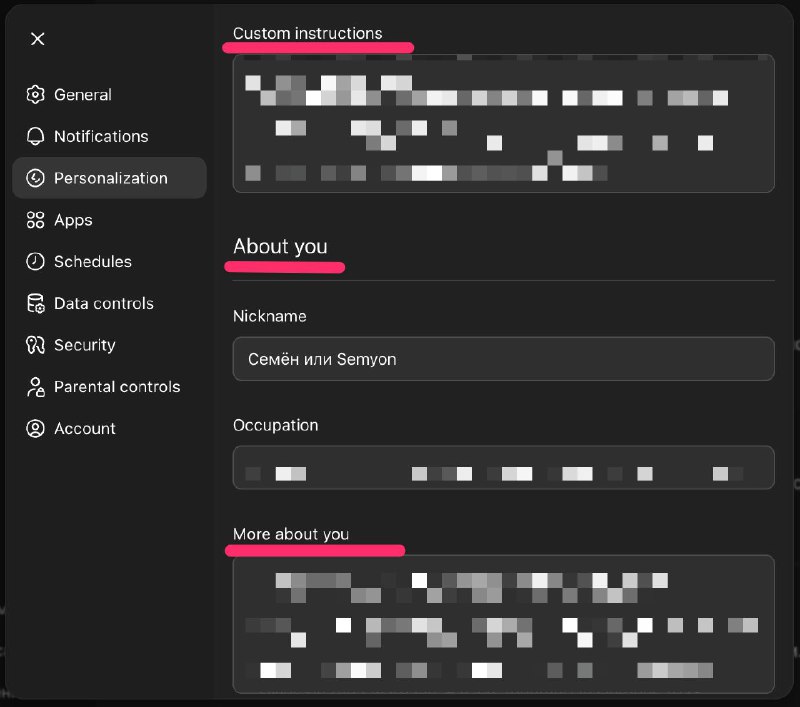
Why the More About You field matters
This field lets ChatGPT personalise its answers based on the context you’ve given it.
An example: ask “Plan a holiday from date X to Y, with budget Z, in country N” with the Custom Instructions field filled in, and you’ll get a well-structured, carefully checked answer that’s easy to work with.
But that answer won’t take into account that:
- you have a dog, so you need dog-friendly places;
- you have a partner, so you’re planning for two adults;
- you have a child, so the search criteria get stricter and the list of possible options shrinks.
Or else you’ll have to add all of this to every request (which is slow and inconvenient).
Custom Instructions + More About You give you a structured, carefully checked, high-quality plan that already takes your life context into account.
To sum up:
- How would you like ChatGPT to respond / Custom Instructions = shapes how the answer is packaged (structure, tone, sources);
- More About You = shapes what exactly gets recommended (the choice of options).
What I put in More About You
Below is a template for the More About You field, based on mine (replace what’s in square brackets with your own):
• I live in [city] ([time zone, e.g. Asia/Tashkent])
• [Who I live with, whether I have children]
• [I have a dog] — by default I prefer dog‑friendly options (cafés/parks/routes/accommodation/trips)
• [I have a car] — you can suggest options with driving, parking and logistics
• I love travel and hiking
• Rule: use the household context only for topics about home/leisure/food/trips/housing/shopping. In work answers don’t mention personal details unless I ask
• If a recommendation depends heavily on whether I’m going alone / with my partner / with the dog — ask 1 short clarifying question, don’t guess
Let’s go through what each line changes:
- “I live in [city] ([time zone])” → time zone, seasons, distances, local realities. Recommendations on “where to go / what to do” get more accurate;
- “In a relationship…” → ideas for leisure, trips, gifts and weekend plans, household planning and budget;
- “[Who I live with, whether I have children]” → it’s clear how many people to plan for and which options suit when choosing accommodation and routes;
- “I have a dog… dog-friendly” → the quality of advice jumps: walks, trips, accommodation, what to check when booking. Details (size and weight, heat tolerance, breed) can be useful, but add them only if you often travel with your dog;
- “I have a car…” → answers account for real-world logistics: travel time, parking, convenient exits, “drive or not”;
- “I love travel and hiking” → more active options, trails, routes and gear tips;
- “Household context only in household topics” → insurance against awkwardness: personal facts don’t surface in work texts;
- “If it depends, ask 1 question” → sometimes one clarifying question saves 10 minutes and prevents misses.
Extra fields that improve answers:
• Diet: “I don’t eat X / allergic to Y / vegetarian”
• Health: “I have limitations to take into account for activity/food/trips (details on request)”
• Comfort/budget when travelling: “I like comfort / I like to save / I’m willing to pay for convenience”
• Constraints: “I don’t like noisy places / I don’t go to clubs / sleep matters / safety matters”
• Leisure preferences: “more nature, fewer malls”
Add with care
Be careful with personal data (your own and other people’s) and overly sensitive information.
For example, before adding to ChatGPT’s context, I ask myself a couple of questions:
1. Can this information about me / my loved ones be found in open sources?
2. What would the consequences be for me and my loved ones if this information became public?
Some examples:
- Your partner’s name, your dog’s name and so on → a strong “wow effect” (you write “my dog ate…” and get back “Don’t worry, [dog’s name] will be fine…”), but this is other people’s personal data. As a compromise, you can keep it in a separate “Personal” project with the rule “don’t use names unless I wrote them in the request myself”, but that’s inconvenient for everyday household requests;
- Your extended family, where they live, their ages → other people’s sensitive data. At the same time, planning gets much more comfortable: the LLM knows whom you mean by family, how many people, their ages, geography and so on. So requests like “I’m planning a family holiday” become far more useful. My advice: if you need context for joint plans or finances, keep it in a separate project;
- Marital status (not to be confused with being or not being in a relationship) → sensitive information that can accidentally pop up where it isn’t needed. When I talk to GPT for “therapeutic” purposes, I prefer to keep that in a separate project with its own context.
First published in my Telegram channel (in Russian) on 17 and 18 February 2026: t.me/raschet7/272 and t.me/raschet7/273.